
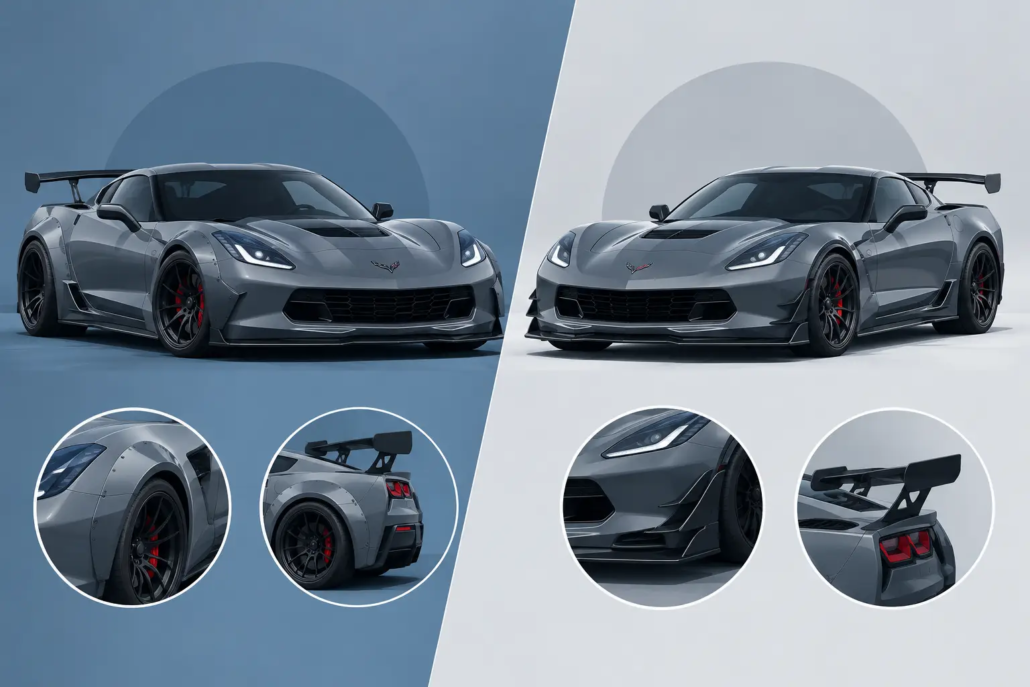
C7 Widebody Versus Aero Kit: Which Fits You?
A C7 Corvette does not need much help to get noticed. The real question is what kind of statement you want it to make when it arrives. In the C7 widebody versus aero kit decision, one path changes the entire silhouette of the car; the other sharpens the factory body into something lower, faster, and more intentional. Both can look serious. Only one may match the build you have in your head.
This is not simply a choice between more parts and fewer parts. It is a choice between a visual evolution and a full visual takeover. A properly executed aero kit respects the Corvette’s original proportions. A widebody conversion rewrites them.
C7 Widebody Versus Aero Kit: The Real Difference
An aero kit works with the factory body lines. Think front splitter, side skirts, rear diffuser, deck spoiler, rear wing, canards, and carbon-fiber accents. These parts add aggression at the edges of the car, where a low stance, forged wheels, and proper wheel fitment can make a factory-bodied C7 look dramatically more exotic without changing its basic width.
A widebody system goes much further. Widened front fenders and rear quarter panels create a new shoulder line, pull the eye outward toward the wheels, and give the car the planted visual authority associated with race cars and high-end exotics. Replacement bumpers, skirts, splitters, spoilers, and related components make the design read as one complete vehicle instead of a collection of add-ons.
That distinction matters because the best builds have a point of view. A C7 with a clean aero package can look like a factory special edition Chevrolet never released. A C7 with a dramatic widebody is not trying to blend in at a Corvette meet, on a show field, or under the lights at a cruise night. It is built to own the frame.
Choose an Aero Kit When the Factory Shape Is the Star
The C7’s original body is already muscular, especially on wide-fender models. If you love the stock proportions but want more menace from every angle, an aero kit is usually the smarter first move. A deep front splitter visually lowers the nose. Side skirts connect the car’s profile to the pavement. A diffuser and rear wing finish the rear with a more purposeful, track-inspired attitude.
This route is also more flexible. You can build in stages, beginning with the component that solves the visual weakness you notice most. Maybe the rear needs more presence. Maybe the front needs a lower, more exotic profile. Maybe your car already has wheels you love, and it only needs carbon-fiber details to tie the look together.
An aero-led build makes sense for owners who drive their C7 often, want to preserve the factory panel layout, or prefer an elevated OEM-plus appearance. It can be less invasive than a full conversion, easier to plan around existing paint and bodywork, and more forgiving if you are not ready to commit to wider wheels and tires.
But restraint still requires discipline. Randomly mixing splitters, skirts, wings, and overlays from unrelated design languages can make an expensive Corvette look unfinished. The parts should share a common visual language: matching carbon weave, compatible angles, and a front-to-rear balance that looks intentional at a standstill.
Choose a Widebody When Stance Is Non-Negotiable
Widebody is for the owner who looks at a stock C7 and sees unused space around the wheels. It is for the build where the tires need more visual authority, the hips need more drama, and the car needs to read differently before anyone notices the badge.
The biggest advantage is proportion. A wider body allows a more commanding wheel-and-tire package, but the goal is not simply to fit the widest possible wheel. The goal is to create a relationship between wheel, tire, fender, ride height, and body contour that looks engineered. When those elements are right, the C7 appears lower, wider, and more expensive from every angle.
A complete system is especially powerful because it gives the build continuity. Ivan Tampi Customs’ limited-edition XIK Widebody Kit is a 14-piece hand-laid carbon-fiber system designed around that total transformation: replacement bumpers, widened fenders and quarter panels, side skirts, spoilers, and splitters that speak the same aggressive design language.
The trade-off is commitment. A widebody build is a project, not a weekend accessory install. It can involve paint preparation, panel alignment, professional installation, wheel fitment planning, suspension choices, and a realistic understanding of how low the car can sit on the roads you actually drive. The results can be extraordinary, but premium bodywork deserves premium execution.
Widebody Wheel Fitment Cannot Be an Afterthought
Do not order a widebody kit, then treat wheels as an afterthought. The wheel setup is part of the body design. Barrel clearance, offset, width, tire profile, brake clearance, suspension travel, and final ride height all need to be considered before the car is assembled.
A wheel that technically fits can still look wrong. Too conservative, and the widened fender loses its impact. Too aggressive, and you risk rubbing, awkward tire stretch, or a stance that sacrifices the clean lines you paid to create. This is where experienced fabrication and alignment work separates a show-car-level build from a car that only photographs well from one side.
Carbon Fiber Changes More Than the Finish
Carbon fiber is not just a dark pattern placed on top of a Corvette. On the right build, it creates contrast, texture, and a motorsport edge that paint alone cannot duplicate. Exposed carbon around a front splitter, side skirt, diffuser, spoiler, or wing can make the body look lighter and more technical, especially against a bright paint color.
Still, exposed carbon needs a plan. A full carbon exterior can be ruthless and exotic. A painted widebody with exposed-carbon aero can create a sharper contrast between sculpture and hardware. Color-matched components can make the body appear more unified and OEM-like, while carbon focal points draw attention to the most aggressive geometry.
Material quality and finish matter at this level. Consistent weave, clean edges, panel rigidity, precise mounting surfaces, and proper clear coat are not minor details. They are the difference between automotive art and a cosmetic compromise. On a premium C7 build, every surface is under scrutiny.
Cost, Installation, and Daily Use
An aero kit generally creates a lower entry point because you can purchase and install components as the build evolves. It is a strong option when you want a high-impact visual return without taking the car offline for a major transformation. Yet quality aero is not automatically inexpensive once you add paint, installation, hardware, possible repair work, and the supporting changes needed to make it sit correctly.
A widebody carries a higher project cost because it asks more from the car and the installer. Beyond the body components, budget for bodywork, paint or carbon finishing, wheels, tires, mounting hardware, alignment, and possible suspension adjustments. If the goal is a complete show build, lighting, interior carbon, steering-wheel upgrades, and rear aero may also become part of the vision.
Daily driving changes the answer. Front splitters and low side skirts demand awareness around driveways, steep ramps, parking blocks, and rough pavement. A wider body can change how you judge the car in tight spaces. None of that means a widebody C7 must live on a trailer. It means the owner should build for the life the car will actually lead, not only for the photo shoot.
The Best Choice Depends on the Reaction You Want
Choose aero if you want people to look twice at a Corvette they recognize, then realize why it looks so much more serious. Choose widebody if you want people to stop, walk around it, and question whether it started life as a Corvette at all.
There is no weak option when the parts are designed with purpose and installed with precision. The mistake is buying for a temporary mood instead of building around a clear identity. Study your car from the side, the rear three-quarter, and the front at ride height. Decide whether it needs sharper edges or a new silhouette, then give the build the parts, wheels, and craftsmanship that vision demands.
